
What Are Blend Words? Definition, Examples, and How to Create Your Own
Say the word "brunch" out loud. You've probably used it a hundred times without ever thinking about where it came from. It's not in any dictionary from a century ago, yet today nobody blinks at it. That's the quiet magic of a blend word: two familiar words quietly merge, and the result feels like it was always there.
Blend words — also called portmanteaus — are everywhere once you start noticing them. Brunch, smog, motel, webinar, blog. You'll find them in everyday conversations, technology, food, marketing, and even popular culture. They're one of the most practical tricks language has for packing two ideas into a single, memorable word.
This guide breaks down what blend words actually are, how they're built, where you'll run into them, and how to make a good one yourself instead of an awkward one.
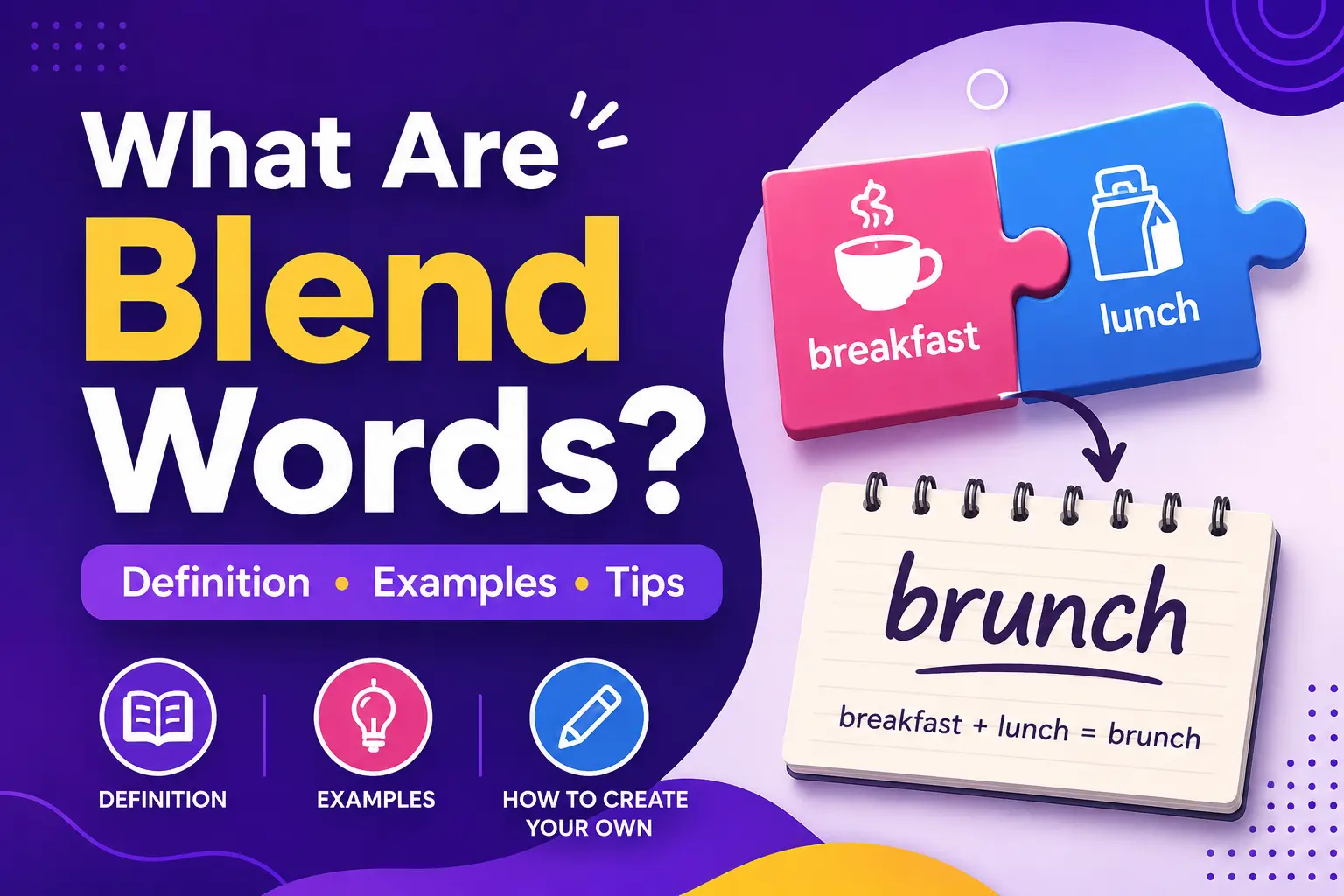
What Are Blend Words?
A blend word (also known as a portmanteau or portmanteau word) is created by combining parts of two existing words into a single new word that carries meaning from both.
That's different from just squishing two words together. A blend word trims each original down to its most useful sound or syllable, then fuses what's left.
Simple definition: a blend word takes pieces of two words and merges them into one new word with a combined meaning.
If you've ever wondered what a portmanteau word actually is, this is it — it's just the more formal, linguistic name for the same thing. The two terms are used interchangeably, though "portmanteau" shows up more often in academic or dictionary contexts, while "blend word" is the more common everyday phrase.
Blend Words vs. Compound Words
People mix these up constantly, and it's an easy mistake to make since both processes create new words.
The difference comes down to what survives.
A compound word joins two complete words with nothing removed. A blend word keeps only fragments of each.
Take "toothbrush." Both "tooth" and "brush" are fully there — you can hear each word clearly. Now take "brunch." Neither "breakfast" nor "lunch" survives in full; you only get "br" and "unch." That's the tell. If you can pull the original words back out cleanly, you're looking at a compound. If pieces are missing, it's a blend.
How Blend Words Are Created
There's no strict formula, but most blend words fall into one of three patterns.
Beginning + Ending Method
The most common approach: take the start of one word and the end of another.
- Breakfast + Lunch → Brunch
- Smoke + Fog → Smog
- Motor + Hotel → Motel
This works because the beginning of the first word is usually what makes it recognizable, and the ending of the second word is what makes the new word pronounceable.
Sound-Based Blending
Sometimes letters get dropped simply because the word sounds better that way, even if it means losing a clean split.
- Electronic + Mail → Email
- Medical + Care → Medicare
Here, the goal isn't preserving every letter. It's preserving how the word sounds when someone says it out loud.
Syllable Blending
Instead of cutting words in half, this method blends along natural syllable breaks.
- Camera + Recorder → Camcorder
- Internet + Citizen → Netizen
Syllable blending tends to produce smoother, more pronounceable results than an arbitrary cut, because it respects how the word naturally breaks when spoken.
Popular Blend Words Examples
Everyday Blend Words
These have become so normal that most people don't even register them as blends anymore: blog (web + log), vlog (video + blog), camcorder (camera + recorder), infomercial (information + commercial), netiquette (network + etiquette), and cosplay (costume + play). Add those to brunch, smog, motel, and webinar from earlier, and you've got a solid everyday vocabulary built entirely from blends.
Brand Blend Words
Many companies also use blend words in their names because they're memorable and often easier to trademark than plain dictionary words — Accenture (accent + future), Wikipedia (wiki + encyclopedia), and Groupon (group + coupon) are well-known examples.
Celebrity & Ship Names
Celebrity couple names are one example of modern blend words — Brangelina (Brad + Angelina) and Bennifer (Ben + Jennifer) are two of the most recognizable, following the same beginning-plus-ending logic as brunch or motel.
Why Blend Words Are So Popular
Language tends to reward whatever's easiest to say, remember, and repeat. A blend word usually beats out its longer description on all three counts.
Nobody wants to say "entertainment that also teaches you something" every time. "Infotainment" does the job in one word. Nobody says "an online seminar" if "webinar" already exists and everyone understands it.
There's also a stickiness factor. A word like "smog" paints a picture the moment you hear it — smoke plus fog — even before anyone explains it. That built-in clarity is a big part of why some blends catch on while others fade.
Where Blend Words Are Commonly Used
Technology — blog, vlog, webinar, netiquette. Tech moves fast enough that new concepts constantly need short, functional names.
Food — brunch, cronut. Food culture loves a good blend, especially for hybrid dishes or meals.
Travel — motel is the classic example, born specifically because "motor hotel" was too clunky to say repeatedly.
Environment — smog remains one of the most widely recognized blend words in everyday use.
Business — companies build blend words into product names and campaigns because they're distinctive and often easier to trademark than plain dictionary words.
Entertainment — movies, fandoms, and celebrity culture invent new blends constantly, from ship names to genre labels.
Tips for Creating Better Blend Words
Making a blend word that actually sounds natural takes a bit more thought than just chopping two words in half.
Start with two related words. A blend works best when there's a real connection between the originals — coffee + chocolate, travel + adventure. If the words don't relate, the blend won't make intuitive sense to anyone hearing it.
Find the natural breaking point. Don't split words in the middle just because it's mathematically even. Listen for where the syllables actually separate.
- Breakfast + Lunch → ❌ Break-fast + Lu-nch
- Breakfast + Lunch → ✅ Br + Unch = Brunch
Say it out loud before you commit. Spelling can trick you. A blend that looks fine on paper sometimes sounds clumsy the moment you speak it. If it doesn't roll off the tongue, try again.
Keep it short. Almost every blend word that's stuck around is short — compare "brunch" to something clunkier like "breakfastlunch," or "blog" to "weblogsite." The shorter version always sticks.
Preserve enough of the original meaning. People should be able to sense both original words, even without an explanation. Smog still whispers "smoke" and "fog" even if you've never heard the word before.
Common Mistakes to Avoid
Splitting words at the wrong place. Random cuts almost always sound off. Stick to natural syllable breaks instead of a mechanical half-and-half split.
Making the word too long. If your blend is harder to say than the two original words combined, it's failed at its one job.
Ignoring pronunciation. A combination that looks clever in writing can still stumble out of your mouth. Always test it verbally.
Combining words with no real connection. The strongest blends pair ideas that already belong together. Forcing two unrelated words together usually just confuses people.
Losing both original meanings. If a listener can't pick up on either source word, the blend loses its main advantage — instant, built-in context.
Frequently Asked Questions
What is a blend word?
Take pieces of two existing words, fuse them together, and you get a blend word — a single term that still holds onto meaning from both originals. Brunch, smog, and motel are all textbook cases.
What is a portmanteau word?
A portmanteau word is really just the more formal label for a blend word. Both terms point to the same thing: taking two words and merging pieces of them into one.
What does portmanteau mean?
The word itself originally described a type of suitcase that opened into two hinged sections. Language borrowed that image for words too — a portmanteau word "packs" two words into one, the same way that suitcase packed two compartments into a single case.
What's the difference between blend words and compound words?
With blend words, you lose letters along the way, since only fragments of each original survive. Compound words don't work that way — both words stay whole, the way "toothbrush" or "raincoat" do.
What are some examples of blend words?
Brunch, smog, motel, webinar, blog, vlog, camcorder, and infotainment all fall into this category.
How are blend words formed?
There are three patterns most blends fall under. Sometimes it's a word's beginning fused with another word's ending. Other times the two get blended purely by how they sound together. And sometimes the split just follows natural syllable breaks instead.
Can anyone create a blend word?
Sure can. All you need is two related words, a spot where they naturally break, and a quick read-aloud test to confirm it flows.
Do blend words become official dictionary words automatically?
Not automatically, no. A blend word earns a permanent spot only after it becomes widely understood, keeps showing up in conversation or media, and actually fills a real gap in how people communicate. "Blog" and "email" both made that leap; most invented blends never get there.
Why are blend words so common in branding?
Blend words let a brand name hint at two ideas at once while staying short and memorable. They're also often easier to trademark than plain dictionary words, which is why names like Wikipedia and Groupon took this route.
Final Thoughts
Blend words are proof that language keeps solving the same problem: saying more with less. Instead of describing something in a full sentence, a well-built blend hands you the idea in one word — brunch instead of "a meal between breakfast and lunch," webinar instead of "an online seminar."
The best ones share a few things in common. They're short. They're easy to say. And they still let you hear both original words if you listen closely.
Now that you understand how blend words work, try creating a few yourself using two related words. If you want to speed up the process, a Word Combiner Tool can help generate ideas.